

Every other home search filters. SumHome weights and scores.
Your buyer sets their own hard requirements and watches exactly what each one costs them. Everything else they want becomes a preference — features that lift a home's score instead of deleting it from the list. They arrive at the showing already decided.
A filter can't tell a "no" from a blank.
Ask any portal for granite countertops and it hands back 34% of the market — not because two-thirds of homes lack granite, but because two-thirds of agents never clicked the checkbox. Filter on that and you don't narrow a search. You delete good homes at random.
Black & white filters mean fewer options and constricted inventory.
- A must-have and a nice-to-have are the same checkbox. The search treats them identically.
- An unchecked box removes the home. Your buyer never learns the house was there.
- Add one more preference and the list can go to zero, so buyers stop asking for what they want.
- What comes back is sorted by price or by date — never by how well it fits the person looking.
The buyer draws the line. Everything else scores.
- Requirements are set by the buyer, who sees the count drop as they set them.
- Preferences raise a home's Sum Score. They never take a home away, so the list can't hit zero.
- An unchecked box doesn't decide anything. Sum Vision reads the listing photos instead.
- Results come back in fit order, and you can open any score and see what produced it.
Buyers SHOW you what they want.
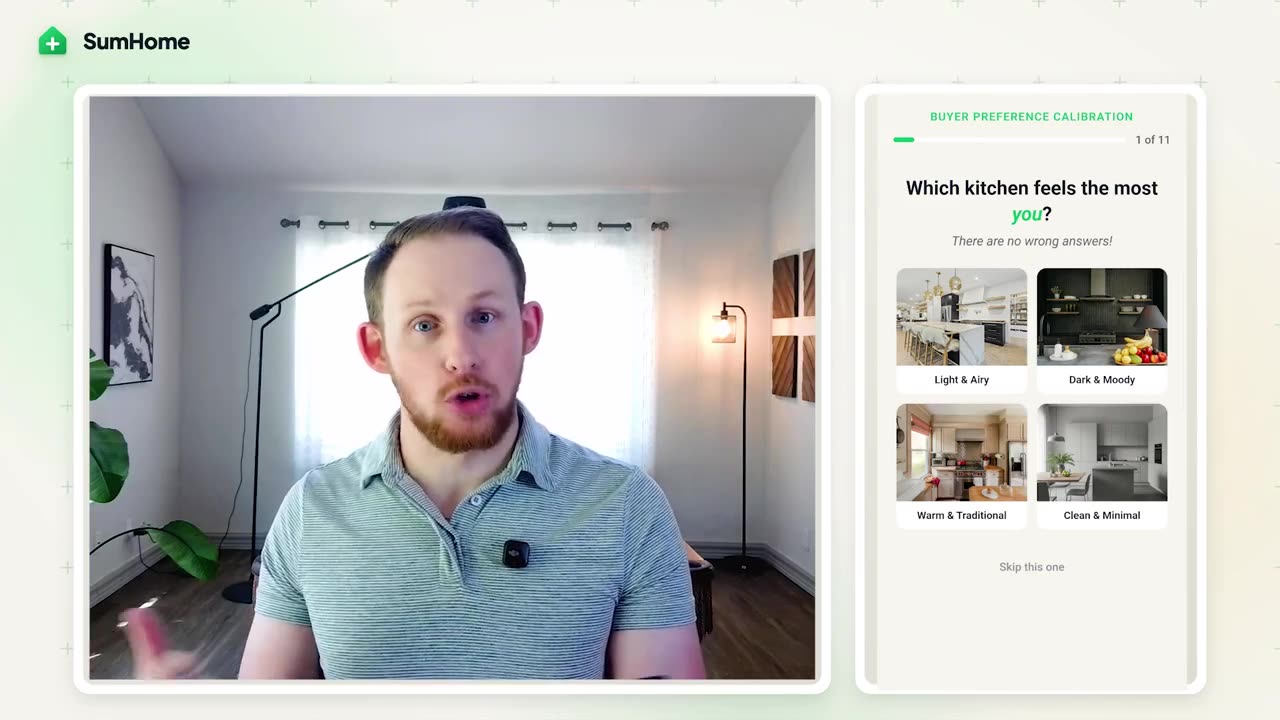
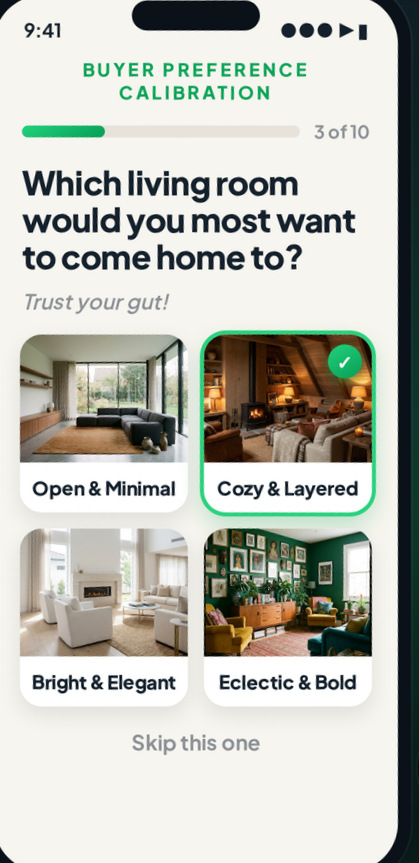
Buyers can't describe what they want, but they know it the second they see it. The assessment shows real rooms and reads the choice, not the adjective — then converts it into weights the engine can actually run on.
- Finishes in under three minutes, before a buyer has a chance to talk themselves out of what they like.
- Separates hard requirements from soft preferences — the distinction every buyer blurs and every agent pays for.
- You get the output. Buyers on a shared search see where their answers diverge before Saturday, not during it.
It reads the photos, not the checkboxes.
Sum Vision runs computer vision across every listing photo in the market and records what is actually visible in the room. It backfills what agents skipped — and captures things the MLS has no field for at all.
- Finds light countertops, subway tile, floor-to-ceiling windows, warm woods — none of which exist as a searchable field anywhere.
- Confirms what the listing claims and catches what it left blank, so a home isn't punished for an unchecked box.
- Every detection is traceable to the photo it came from. Nothing is asserted that isn't visible.
"Granite" appears on 34% of DFW listings. Sum Vision is how we find the other homes that have it.


First you decide what you must have. Then you say what you'd love.
That separation is the patent. Not a smarter filter — a search where the buyer draws the hard line themselves, sees exactly what holding it costs, and then spends everything else on preference.
The buyer sets the must-haves, and sees what each one costs.
They mark what they will not go without: price, beds, baths, square footage, a single story, a garage, a study, the school zone. The count moves the instant they mark one. That number is the point of the stage — they either accept the smaller world or loosen the requirement. Nobody eliminates a home on their behalf, and nothing is dropped that they didn't personally choose to drop.
Everything else raises the score.
Now they say what they'd love: granite, warm woods, a big island, an open plan, soft afternoon light. None of it removes a home. Each preference lifts the homes that have it, weighted by how much the buyer said it mattered — so the strongest fits rise to the top of a set they already agreed to. That ranking is the Sum Score, and it never returns an empty screen.
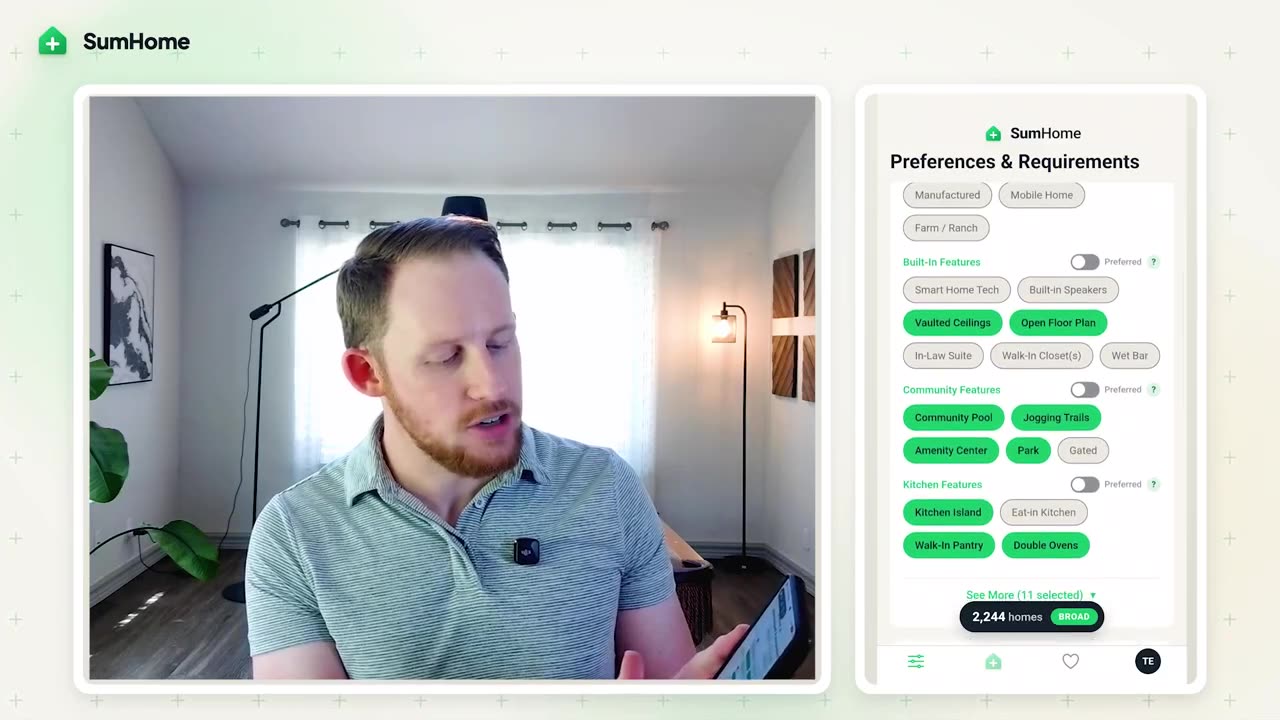
Two decisions the rest of the industry collapses into one checkbox list. Keeping them apart is what lets SumHome personalize aggressively without ever handing a buyer an empty screen.
Get your buyers into the betaAmerica's largest home buying generation is swiping through the most important decisions of their lives.
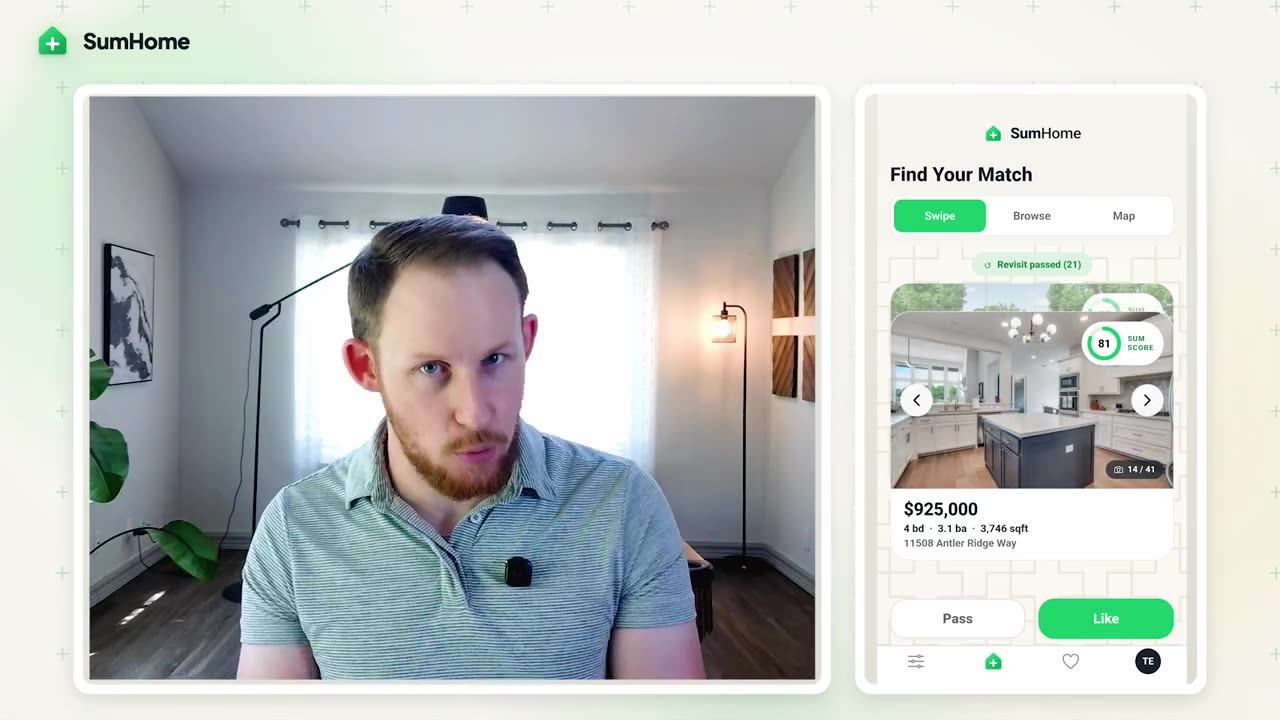
They chose their partners this way. They are not going to sit through a spreadsheet of four hundred listings to choose a house. SumHome hands them the interface they already trust, and the engine decides what goes in front of them.
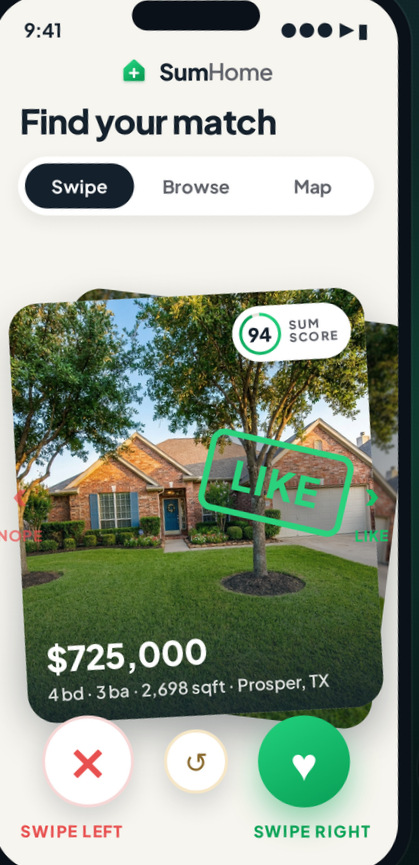
- Every card carries its Sum Score, so a swipe is a judgment, not a coin flip.
- Swipe right is a tour request that lands with you, not a bookmark that dies in a browser tab.
- Every swipe feeds back into the weights, so the deck sharpens as they go.

Show your work. Every time.
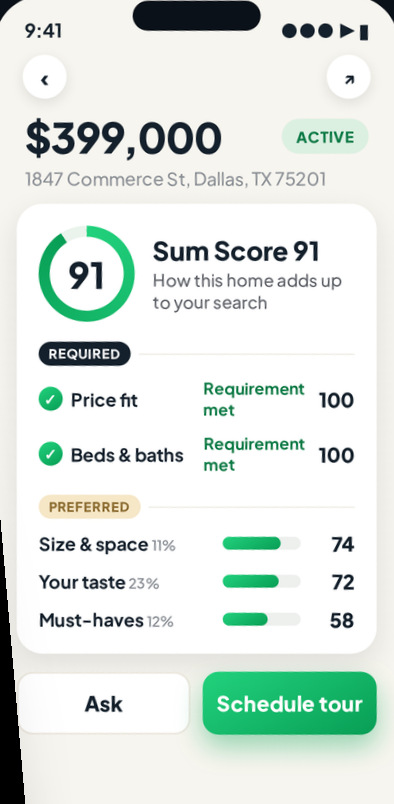
A number nobody can interrogate is just another black box. Open any Sum Score and the whole calculation is there — which requirements were met, which preferences were weighted, and how much each one contributed.
- Requirements and preferences are reported separately, never blended into one vague match percentage.
- Weights stay visible and editable — if a buyer's priorities shift on the drive home, the ranking shifts with them.
- You see the same breakdown they saw, so the tour conversation starts where it used to end.
What agents ask first.
Anything we haven't answered, ask on the waitlist form — it comes straight to us.
Is this a portal that's going to take my client?
No. SumHome is a tool you hand your buyer, not a lead marketplace. The buyer stays attached to you, tour requests come to you, and we don't sell your client's attention to anyone.
What does it cost during the beta?
We expect it to cost no more than $40 per brokerage that joins the beta. That's a pass-through cost to obtain MLS data, not a profit figure.
Which markets does it cover?
Dallas–Fort Worth first, on live NTREIS data. The engine is market-agnostic, and new markets are in the works.
What is patent pending, exactly?
The dual-stage decision method: letting the buyer definitively set their own hard requirements, then converting the preferences they state into weighted scoring that ranks homes rather than removing them.
What do you need from me as a beta agent?
An email address, your willingness to personally navigate the app, and your willingness to give us detailed feedback.
Be among the first to test the patent-pending SumHome product.
We're onboarding a small group of agents and brokerages before general release. Tell us about your business and we'll get you in.
Join the beta waitlistTwo minutes. No demo call required to get on the list.